

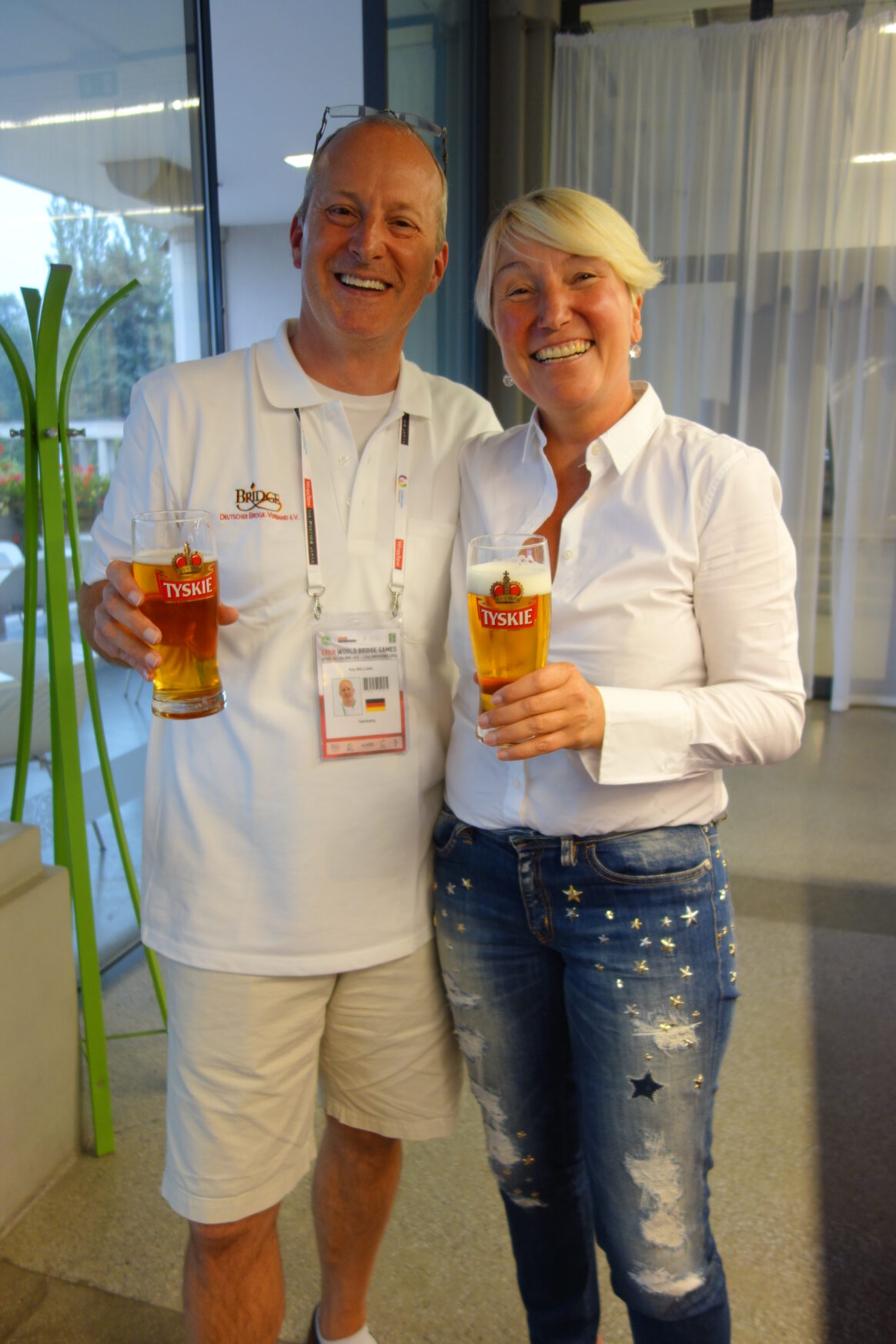

Interview with Samantha Punch: Las Vegas NABC, July 2014
Sabine Auken (born 1965) is German but lives in Denmark. In recent years she has competed successfully in Open bridge events with regular partner Roy Welland, who is also her life partner. Arguably the most successful woman player of all time, she has won Open, Mixed and Women’s events in World, European and North American championships.
Why do you play bridge?
I don’t know. I just love it. It’s just so much fun. It has so many different facets and it’s not just one way of thinking, it’s putting things together. To me it’s a little bit like detective work. There are some clues out there. You don’t know what they are and where they are, so you have to go and find them. Once you have found them you have to put them together like a puzzle and then draw the right conclusions so it’s really multifaceted. To me that’s fascinating.
Is there anything you don’t like about the game?
I wouldn’t say anything major really. I mean, I object to some people’s behavior. And some say bridge can bring the worst out of you and some people behave really badly at the bridge table. But I also think it’s extremely interesting why that is the case. For example some players, especially when they feel that things are not going well for them, then they try to intimidate their opponents. I can fight back, but I think it’s really a problem for less experienced players who want to come and enjoy the event when they get treated like that.
What would you say are the key qualities of a top player?
Discipline. I think it’s important to have discipline at the bridge table, partnership discipline. Getting upset at the table, it doesn’t improve your game, it doesn’t improve your partner’s game. I can get upset later and have discussions and get really upset, but while the play is going on I think it’s important to just carry on. If you can’t control yourself, you can be successful at times and you can win events, but I don’t think you will be successful in the long run. As well, the most successful bridge players have a special talent of combining things. In the US a lot of top players were options traders, for example. It’s really related, you very quickly combine things in your head and draw the right conclusion and then act on it. I don’t know what to call it. Physical fitness, too — usually when I’m at home I do something every day, I go running or I go swimming. I just feel better. I feel clearer in my head. I have more confidence.
Why is confidence important at the bridge table?
It’s a strange thing really. Sometimes a person comes to your table and you can feel that they are really on a good run and you know they are going to have two tops against you and then they leave and they did have two tops against you. It’s also possible the other way around.
But the worst thing you can do is to be arrogant and think that nobody can beat you because at the bridge table everybody can beat you. So that’s bad. Very bad. No, I’m more thinking of a positive confidence. Thinking you can do it but at the same time knowing that there’s no sure thing.
Is there ever a case where you do something different because you are playing a stronger or a weaker team?
Oh definitely, we change our style from being more or less aggressive, for example, with our preempts. But those are also state-of-the-match decisions. If you feel like you need some points you tend to be more aggressive or try to do something, create something. And that’s what one usually would do against really good teams where we feel we are the underdogs. Just by playing normally we probably won’t win, so we need to do something.
Do you think any particular aspects of the game are more important than others? Like being a good partner, bidding, declarer play, defense?
Well I’m glad you started off by mentioning being a good partner. There hardly would be one example of success just as an individual. Usually you think of partnerships and if you want to be successful in the long run that’s a key element. I think the most important aspect is respect. You have to respect fully your partner. If you don’t have respect it won’t work in the long run. Everybody is different so trying to know and understand your partner and be empathetic and work together, to do the things that are good for your partnership. You can only do that really if you try to understand your partner as a human being. I mean, in some partnerships people yell at each other and it’s fine because it makes them feel good, they like it, it makes them feel better. And if you are fine with that I don’t see any reason not to do that. But if you know that your partner doesn’t like it, it would be very bad to do that.
How important do you think system is?
I don’t really think system is that important at all. It’s important that you feel comfortable with it. The most important thing is that you know what you are doing and that you are on the same wavelength as partner. You can play the best system in the world but if one player in the partnership only knows half of it, it won’t help you at all.
How important are teammates and team spirit?
I wrote about that in my book, I Love this Game. I don’t believe it is necessary to be great friends to be a successful team. But you all have to work for the same goal and you have to know your place in the team. For example, there can be a star pair who are supposed to play more matches than the others and then there can be a pair who are considered the third pair and play very few matches. It’s important that you fulfil your role, that you are okay with it, that you feel good about it. If you do this, you will be a good teammate and you will further the goals of the team.
And things like knowing suit combinations, because you talk about them sometimes in your book, how have you gone about getting to grips with them?
Honestly I don’t know most of the suit combinations. I’m very bad at percentages. Roy’s great at it, he knows all the probability stuff, I haven’t got a clue. I feel it’s very rare at the bridge table that it boils down to straight probability. There are so many other things to take into consideration: the bidding, what they bid and if they didn’t bid, that’s also a clue, the way the cards fall, what they discard. I usually just try to get a picture of the whole deal that way instead.
What would you say are your strongest points as a player?
I would say probably my ability to concentrate and totally block other things out. I feel like when I am at the bridge table I don’t hear anything else. There used to be something that really annoyed me a lot, and it still does a little bit, but not as much anymore. It’s when people don’t sit still, they move around all the time or play with their pen or whatever, I don’t like that at all, it really gets in the way of my concentration.
How did it come about that you started playing with Roy?
I had for a very, very long time wanted to play Open bridge, to stop playing women’s bridge and play Open bridge. Daniela [von Arnim] and I had made some efforts in the past and we weren’t successful, probably for a variety of reasons. I much prefer playing Open bridge. To me that’s what real bridge is. I think it’s fine to play women’s events. I think it’s great they have those competitions, but I think it’s important that if you want to do something else that you have the possibility to do so. To play the big game, where all the best can play, it’s not restricted. In women’s bridge, it’s only women that can play and it’s just not considered as having the same value.
Given that women’s bridge is restricted to women, there must be some advantages and some disadvantage to that?
I personally feel that there is a lot of learned behavior and I believe that as children we become influenced from the very beginning. Most boys get blue clothes and the girls get pink clothes, and that’s the start of it. It’s generally assumed that boys are much better at mathematics than girls and somebody did some research with teachers. When they taught mathematics to boys and girls in the same class, the boys performed much better and the girls did much worse than the boys. Then when they split them up, teaching them the same thing, the girls performed just as well as the boys did. Because all of a sudden they didn’t feel that pressure of being compared, feeling they were not considered as good as the boys. So I’m thinking, on those lines, maybe it’s a good thing that there’s a women’s competition. Because it’s the same in bridge. I can imagine that part of it may be that everybody, or almost everybody, believes that men generally are better bridge players than women. That’s how we grow up as bridge players, so to me that is learned behavior. If you are told every single day that these guys are better than you girls, then that is learned behavior.
Bridge is a sexist game. I have lived in Denmark now for 20 years and probably the Scandinavian countries are the least sexist countries in the world. There’s a lot of equality in those countries which is nice. But I feel generally that the further east and south you move in Europe, the more chauvinism you meet, especially at the bridge table. And you can just feel it when they almost get a little bit upset when you do something good against them. You can feel a certain arrogance, certain expectations that of course they will beat you.
Since Roy and I have had so much success recently in Open bridge I have felt less of that. I have felt that I was much more respected as an equal even by the southern and eastern European people and playing in the European championships recently, I felt totally accepted as an equal.
In your book you said that what you like about bridge is it brings men and women together to compete on equal terms.
We have the possibility. We only need to grasp it. And it’s up to every woman whether she wants to participate in that or not. I understand that very often women are forced to play women’s bridge instead of Open bridge because of financial constraints or whatever and maybe they would prefer something else and that’s unfortunate. But, apart from that, the possibility is there if you don’t have those constraints. Listen, I mean I could have played Open bridge instead of women’s bridge but I wouldn’t have had the same success. And having success is nice, it’s a good feeling. It’s one of the things that keeps you coming back.
When you said that you and Daniela tried for the Open team. What were some of the reasons why you weren’t successful?
We tried to get on the German Open team and we didn’t really have the time to practice and put a lot of work into the partnership and really be as good as we can be. I also believe that in Germany they didn’t really want us on the Open team because we were important to have on the women’s team. As long as we were on that team there was always a chance we would win a medal and they didn’t want to lose that. So there were some powers in Germany trying to prevent us getting on the Open team. Very often there were no trials in Germany, so we played once in the Open trials and we didn’t have trouble finding teammates and we lost in the final. There were other times when we couldn’t participate because it would have meant three extra-long weekends away from home and I would have had to travel from Denmark and with everything else it was not really feasible for us.
Do you have anything specific that you do to prepare yourself for a really big event?
Not really. Krzysztof Martens has written a series of books, Bridge University, and there are a couple on really difficult play problems and I like reading some of those before tournaments. They are really good and they get your mind on the right track. On the actual day, I like to go and do something first, like running or swimming. But I don’t feel nervous, I never feel nervous at the bridge table. And pressure in a way can be a good thing because it generates adrenaline and I feel that it improves your performance. It makes you focus better, be more spot on.
You’ve played both with Jens [Auken] and now with Roy. What’s your secret, because so many people can’t play bridge with their life partner?
As I said before, I think the main ingredient of a good partnership is respect. And as long as you respect your partner I don’t think there is a problem. I believe that many, many couples have a respect problem in bridge terms. And it’s not always the man not respecting the woman. Roy and I sometimes get into loud discussions, well maybe not loud but serious discussions afterwards if something has come up that we totally disagree on. We are both pretty strong-minded and maybe even stubborn at times. It doesn’t happen very often but it happens. I guess it’s just sometimes you have to get it out of your system and then it goes away. Sometimes a little fight can be good.
And a difficult question, you might not want to answer this, but where would you see your ranking among the top players?
I don’t really know. I don’t consider myself as a great player and I feel I’ve been very lucky to be able to play as much bridge as I have and to be in the situations that I’ve been in. There are many talented players that don’t have the same opportunities so I consider myself very lucky as far as that goes. And so you know, I’m not like a brilliant player, I consider myself a hard worker and I consider myself a fighter, with a will to do well. That has helped me a lot in the past. I don’t even think it makes sense to have a ranking for individual bridge players because you play in a partnership. And ranking, if you look at Roy’s and my results, it’s like neither one of us is a great technician but we’ve had a lot of success, partly because of our different approaches to the game. And that’s just part of the success. So if you want to put us in a ranking, if you look at our results the past couple of years there is probably hardly a pair that’s had better results. That doesn’t make us the top pair, we just had good results.
And final question, what advice would you give to someone who is trying to get better?
In the beginning, I did a lot of reading, I read a lot of bridge books which helped me a lot. I still think Martens’ books are absolutely great, and discussing bridge with experts, like really discussing it. I feel I was very fortunate when I moved to the United States after I graduated from university. I spent some time here, I had the opportunity to do that a lot, and it improved my game tremendously. Even just try to sit and watch and then try and discuss things with them afterwards if that’s possible. One shouldn’t be shy. Many of the good players like discussing bridge, and that makes a huge difference, trying to understand how they think.
Sabine’s Top Tips
- When your opponents explain ‘no agreement’ or ‘don’t know’, treat the situation as if they were using your own methods and bid accordingly.
- Never leave the table during a match without asking everyone at the table whether they would like a glass of water.
Sabine’s interview is part of BAMSA’s Bridging Minds project. Her interview is one of 25 with world class players that can be found in the book: Bridge at the Top: Behind the Screens.
Thanks to Christian Arp-Hansen for the photo of Sabine.