

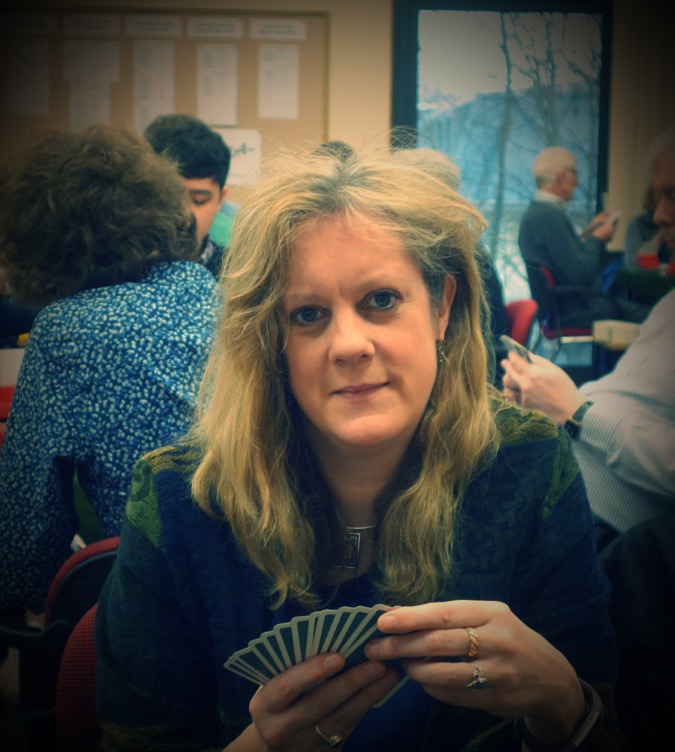
A conversation with Professor Samantha Punch by Francesca Canali from the European Bridge League.
She sits among you at every major tournament. She plays, she competes, she travels from city to city like everyone else. But while you obsess over squeezes and endplays, she is quietly observing something else entirely: you. How you interact, how you fight, how you build partnerships and break them, how you forgive (or don’t).
Professor Samantha Punch is a sociologist at the University of Stirling, a Scottish international player, and the mind behind BAMSA (Bridge: A MindSport for All). She has written two books on the human side of elite bridge and published dozens of academic papers dissecting our community with the precision of a scientist and the empathy of someone who truly belongs to it.
We asked her to tell us what she has observed, openly and honestly. What she told us is fascinating, sometimes uncomfortable, and deeply recognizable.
Tell us a bit about yourself.
I’m 55, originally from England but I’ve been living in Scotland for a long time. I live with my life partner Stephen Peterkin, who is also my bridge partner, so our world is very much bridge!
How did you learn to play?
After finishing my PhD, I was looking for something to fill the gap. I just showed up at a bridge club, almost on a whim. They told me I had to take lessons first, and I didn’t quite understand why. I thought they could just explain the basics and I’d be fine! But they were already on lesson 11, so someone brought me the notes for lessons 1 through 10. I read them and joined the group halfway through. And that was it.
What is your proudest bridge achievement?
Probably getting to the semi-final of the World Bridge Games in 2016, in Wrocław. But it was also incredibly frustrating. We were beating France in the semi-final after the first half of the 96-board match, but we lost in the last quarter. Then we played China for the bronze medal and lost that too, after being ahead in the first set. So we came away with nothing. It was my best moment and my worst moment at the same time.
Perfect material for a sociologist, right?
Absolutely. A double-edged sword, as always in bridge. It was really painful to come away empty-handed after nearly two weeks of competition. I think our team just got a bit too tired.
You’re a Professor of Sociology, but your academic path is quite unusual.
Yes, I always say I’m a professor of sociology with no formal sociological qualifications! My first degree was in Latin American Studies, with Spanish, Portuguese, and a dissertation on children in Bolivia. Then I did a PhD in Geography and Development Studies, looking at rural childhoods in South America. My first job was in Social Work at Stirling, studying teenagers in Scotland. The common thread was always childhood, and really, the work was sociological in nature, even though I was trained in other disciplines. When I realized that, I started publishing in sociology journals, teaching sociology, and one great way to learn a new discipline is to teach it. I was always one step ahead of the students!
Can we consider the bridge community a small society?
Absolutely. It’s a microcosm of society. It incorporates much of what we see in broader society. But a couple of things make it unique. First, because it’s a partnership game, we’re always working with someone while playing against others. It’s a very relational society: cooperation and harmony on one side, conflict and tension on the other.
Second, particularly at the top level, you’re dealing with very intelligent people. You don’t have to be especially clever to enjoy bridge socially or at club level, but at the very top, there’s a lot of smart individuals. And that can mean we’re quite a critical community. We tend to take things apart and question them, rather than seeing the good in them. There’s a sharpness to our community that has a downside: we can be overly critical, even negative. But the other side of that coin is that we can also be a warm and supportive community that looks after each other.
At the top level, people travel from one tournament to the next, always meeting the same faces around the world. It’s not a regular job where you go home and separate work from personal life. How does this shape relationships?
I think there’s a big distinction between professional and amateur players. I’m an amateur. I can be extremely competitive at the table, but away from it, I don’t have to worry about competition. I can have friendships, community, networks.
For professional players, it’s harder. They’re competing not only at the table but also away from it, for sponsors. And the sponsor pool is shrinking: there are fewer very wealthy sponsors coming through, while the number of professionals keeps growing. That creates real tension, because this is their livelihood, this is how they pay the bills.
From the interviews I’ve done, I’ve heard about some of the less pleasant maneuvering that can happen. If you’re playing on an amateur team, you can freely admit to mistakes. But on a professional team, if your contract isn’t secure for the following year, you might be tempted to highlight your teammates’ mistakes more than your own. It creates an ambiguous kind of community: on one hand, you’re socializing and having fun with friends; on the other, you’re competing for a smaller and smaller job market.
How does this constant duality of friendship and competition shape a person’s personality over time?
I think people learn to navigate it in their own way. Those at the very top, who are more secure, can afford to just be themselves. But for those in the tier just below, it’s a difficult tightrope to walk. There’s a lot of uncertainty: contracts are precarious, sometimes only for a year, and I’ve heard of them being broken along the way.
Is it possible to have real friends in the bridge world?
That’s an interesting question. Even as an amateur, all my holidays go to bridge. The last non-bridge holiday I had was about 20 years ago! Most of my weekends are bridge too. Over time, my friends outside bridge got tired of me never being available. They’d invite me to their 40th birthday or their wedding, and it would clash with a tournament I’d committed to months in advance. Gradually, those friendships faded.
And now that I also research bridge, there are no boundaries left between work and play. I’m always observing, always making connections, even when I’m playing.
So over the years, I’ve lost many of my non-bridge friends, and I’ve become more dependent on the bridge community. I genuinely believed those were real friendships. But I know of situations where someone very active in the bridge community went through a difficult time, and the support from bridge friends was much less than expected. Old non-bridge friends would probably have rallied around more. Many bridge friends were just… absent.
I think as bridge players, we can be a bit selfish inside our bridge bubble. When we see people, we’re great with them. But when we don’t, it’s out of sight, out of mind. We assume people have other networks, but for those who’ve given up their other networks for bridge, it can become very isolating.
That said, I’m sure this isn’t the same for everyone. But it does raise the question: are bridge friends truly real friends, or just bridge friends?
Could there be a link between the personality it takes to become a top player and the ability to form deep personal connections?
I think so. In one of our studies, we looked at different types of players: competitors, socializers, self-improvers, and mind-gamers. There’s a real distinction, especially between competitors and socializers.
To reach the elite level, you have to commit intensely, to the exclusion of many other things in your life. That focus on the game can come at the expense of relationships. And there may be another element: some highly intelligent bridge players might have slightly less emotional intelligence. If you’re exceptionally good at cards, you might be less skilled at managing difficult emotions and relationships. So when something difficult happens, you avoid it because you don’t know how to respond.
But I wouldn’t say friendship is impossible. In my academic career, there’s plenty of competition too, yet you still make good friends among competitors. I think the key difference is that in a regular job, there are structures to protect people: workplace policies, employment regulations, clear pathways. In bridge, everything is much more informal. Contracts aren’t as robust. And that informality is what makes the trust issue more insecure.
What are your views on the women’s category in a mind sport?
My views have evolved. I started out strongly believing we should get rid of it. I still think it’s problematic in some ways, but I now feel it exists for a reason. Gender inequalities persist. Women still carry the bulk of childcare responsibilities, and at key points in a bridge career, they simply can’t invest the same time as men. There will always be some structural inequalities.
Attitudes are getting better. People are making fewer assumptions than they used to, and I think it has improved compared to 20 years ago. But until we reach genuine equity in training opportunities, playing opportunities, and access to the best partners and teammates, the women’s category serves as a necessary safeguard.
The mixed category is becoming more important, and I’ve heard young women themselves starting to say they don’t see the need for a separate women’s category. When that generation feels they’re competing on truly equal terms, perhaps we can gradually phase it out. But it could take a very long time, and the childcare issue might mean we never fully get there.
And the seniors’ category?
I think it makes sense. Although you can play bridge throughout your whole life, most people do start to slow down. Thought processes change; it gets harder to remember a complex system. And as people live longer, the category is getting broader. Someone actually raised at the EBL seminar the idea of a “super senior” category, separating players aged 60+ from those aged 75+. There is a real difference between playing bridge at 60 and at 75, and if we have more and more people in their 80s wanting to compete, it might be worth considering.
Tell us about BAMSA. How did it all start?
It started in 2013. As a sociologist who also plays international bridge, I simply wanted to interview my heroes, pick the brains of the world’s best players, and understand what goes on behind the scenes. The life of a professional bridge player is quite unique, and I was genuinely curious.
My plan was modest: do a couple of interviews at each tournament I attended, and after a few years, I’d have enough material for a book when I retired. But I was enjoying it so much that I thought, why sit on all this? At the same time, I’d been researching the sociology of childhood for over 20 years and was running out of fresh ideas. This could revitalize my research by connecting it to something I loved.
And there was a legitimate academic case for it. Bridge connects to community, well-being, mental health, brain fitness: these are major societal issues. It’s not just a bit of fun. From the research, very clear themes emerged around power inequalities, the professional life, and especially gender inequalities. I realized the bridge world had no gender policies whatsoever, while every other sector of society did. As a sociologist, maybe I could encourage some of those policies to be developed.
How was it funded?
I started very small. A friend gave me literally 300 euros to get my first interviews transcribed. Then EBED (English Bridge Education & Development) gave me a small grant for a survey on bridge and well-being. We got over 7,000 responses from that, which produced a solid paper. Each success built credibility for the next step.
The EBL and WBF were supportive early on with small grants that we could do a lot with. Then came our first big funding: the WBF contributed about 27,000 €. That was a game-changer.
As people saw we could deliver, that we published results and created accessible resources like videos, podcasts, and summaries, the crowdfunding became easier. Then Mike Levine from the US offered a matching grant: 100,000 dollars, on the condition that I raised another 100,000 first. That took a lot of work, but it was easier because of the track record we’d built. Norway has also been very supportive from the start.
For our current study on bridge in schools, we chose England, Scotland, the USA, and Norway precisely because those are the countries that really understood what we were doing and saw the value in evidence-based research for lobbying governments and getting bridge into schools.
We now have a new PhD on bridge funded by the Scottish Government, the University of Stirling and the WBF.
Is bridge too complex for modern society?
It’s another double-edged sword. On one hand, yes, we need to make entry points simple, fun, and engaging. But on the other, we shouldn’t dumb it down too much, because its complexity is what people love. From our interviews with young players, some say they don’t have time to invest in learning the whole thing. But others say they love that you can’t master it quickly, that it’s challenging, that it makes you think. And because it’s scaffolded in stages, you can enjoy it at each level.
I think the solution is to keep the traditional competitive format but introduce additional, more accessible formats alongside it. Like chess did with blitz and rapid. We need faster games, shorter formats, more flexibility. The “drop-in” idea is interesting: instead of committing to a three-hour club session, you play in one-hour segments and can come and go. Some people stay the whole session, others just play for an hour.
Bridge Battle is a good example of making the first encounter exciting and engaging. It’s got characters, fun terminology, tangible outcomes. And Norway’s cute animations are wonderful for that very first step. But we need to think carefully about how to transition people from those fun introductions to actual bridge.
We also need practical solutions at the club level. I heard about an idea from Florida where beginners play alongside the regular session, supervised by a different club member each week. The beginners get three “chips” that they can use to ask questions. It makes them think about when to use their questions rather than becoming dependent on constant help.
And we desperately need something like “The Queen’s Gambit” for bridge: a mainstream cultural moment that shows the diversity and excitement of the game. We have the stories for it. We have the scandals, the drama, the human interest.