

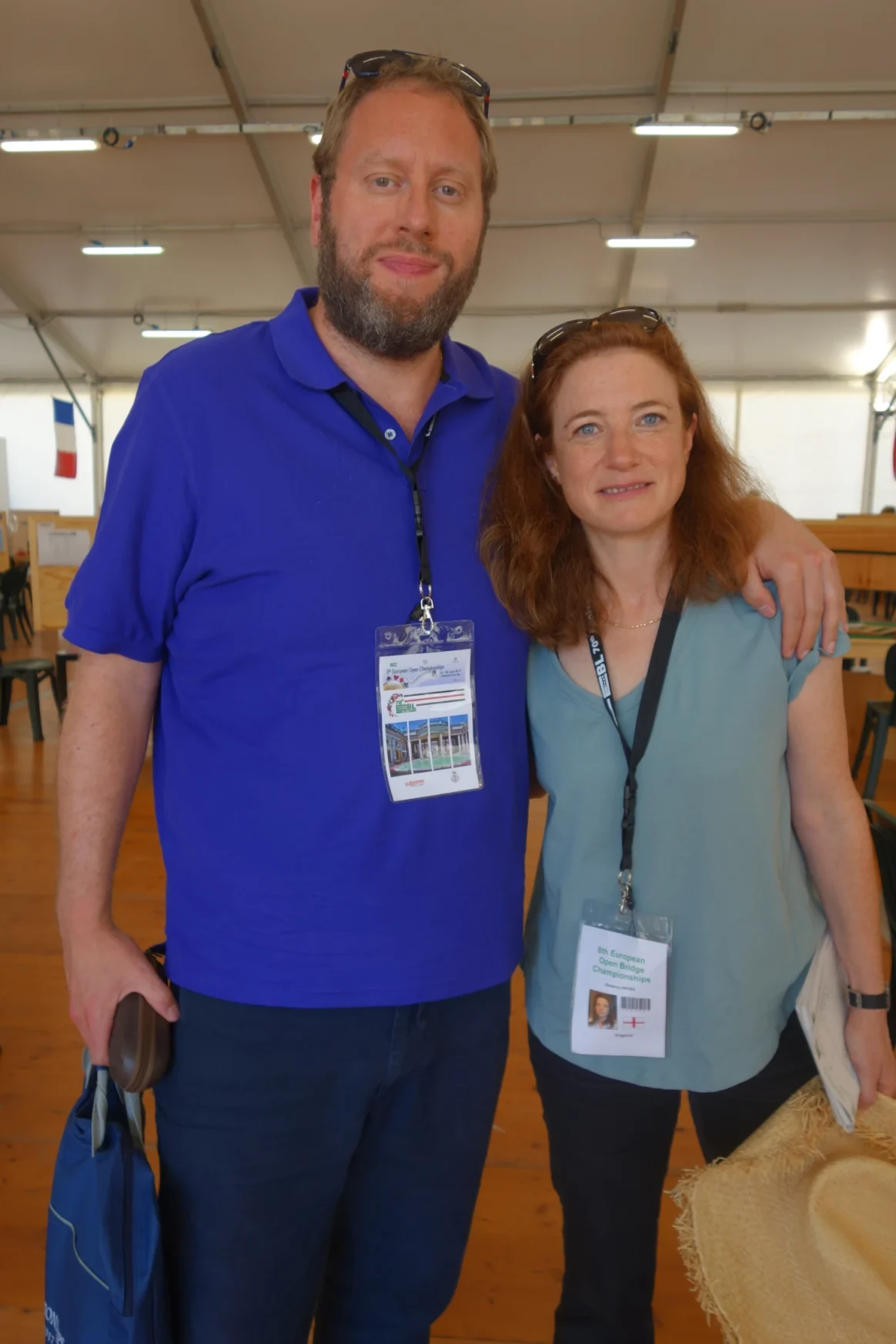
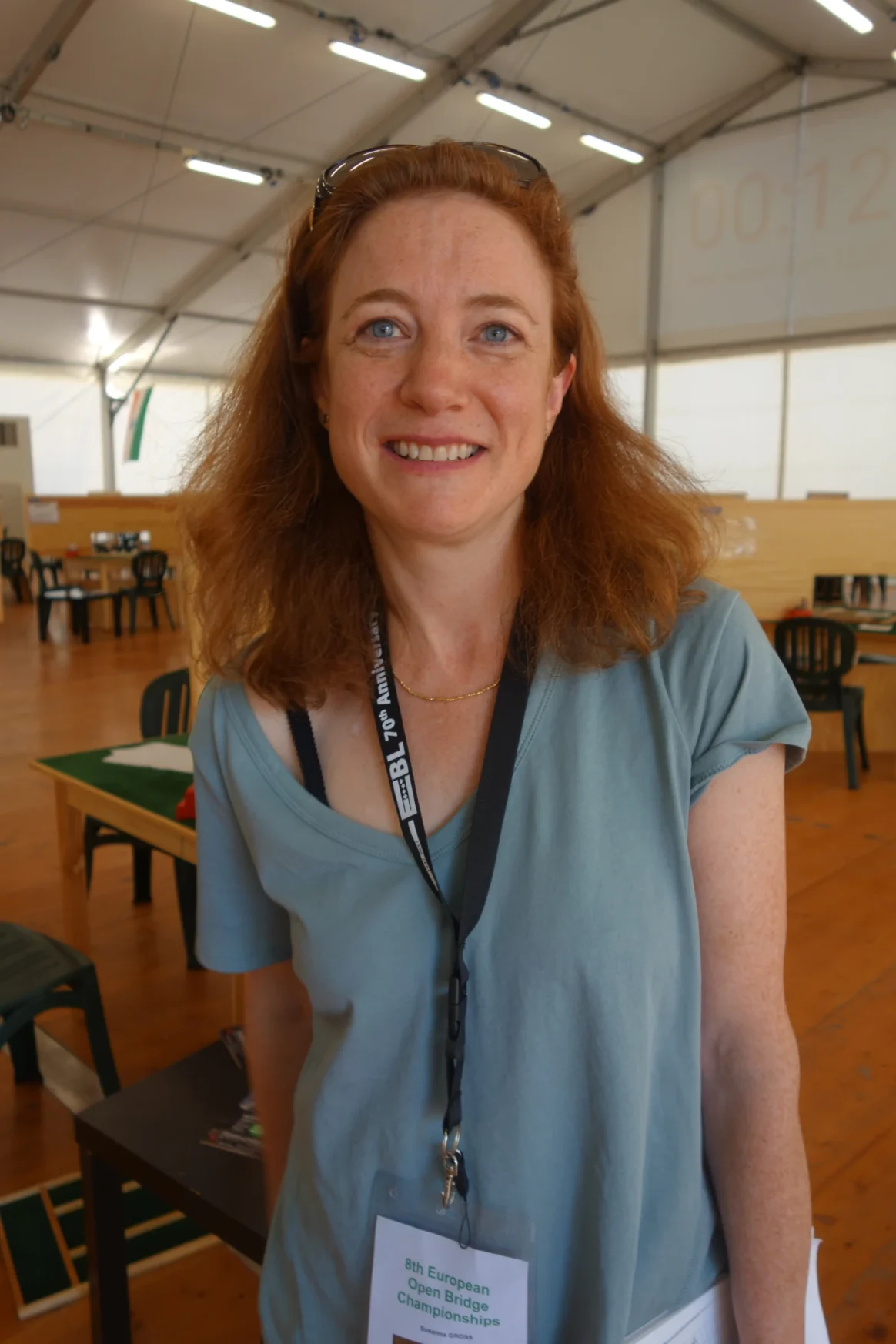
Interview with English bridge player, Susanna Gross, by Samantha Punch, August 2014
When I mentioned that I was doing a project on the sociology of bridge you said ‘oh wow that’s great, that’s my favourite topic’ – why’s that?
Are you asking what I think of the sociology of bridge or why I answered that I love talking about bridge?
Both. We’ll start with the sociology of bridge – what do you understand by it?
My assumption, and without knowing, is that the sociology of bridge involves the reasons people play, the reasons people enjoy bridge, the benefits it gives them. I’m assuming it’s got something to do with the psychology of why people play. The type of people that are drawn to bridge. Why some people find it addictive, what role it plays in their lives, how it changes their lives, that sort of thing.
I think it’s all of those things. And, why do you love to talk about it?
The reason I love talking about it is because I’ve devoted so much of my life to caring about and thinking about bridge. I obviously want to know why, and whether I’ve been wasting my time, and what is this passion? Is there a common factor in the types of people who are drawn to bridge? Why have I allowed it to play such a central role in my life? All these questions.
Here’s another thing that continually intrigues me: why do I find the very top bridge players the most impressive people that I know, as opposed to those people who reach the top in other areas, surgeons or artists or writers or whatever. What is it that so singularly impresses me about those who play bridge well? It’s because of my own lifelong struggle to play well, and the sense of my own limitations. I feel that bridge is a direct test of my intelligence, and so when I see someone who has none of my obvious limitations, whose brain can absolutely see with great clarity the conclusion which I am unable to reach myself, I’m just so impressed.
I think it’s very, very rare in life that one gets the chance to measure intelligence in such a stark way. Playing bridge isn’t a matter of opinion or taste, you’re directly measuring someone’s else skill against your own. You can’t say: he made four spades because he felt like it and I just wasn’t in the mood. They either played better than you or not. I’m fascinated by the extent to which the game is a raw test of intelligence, and if it is, what sort of intelligence. Can intelligence be measured like this? Or is it only a test of a particular type of intelligence? For instance, a lot of excellent bridge players that I know are rather limited in other ways. Their interests are rather narrow, they can be rather blinkered socially, for instance.
What do you mean by that?
I remember a situation a while ago when I was at someone’s house with some fantastic bridge players, we were all chatting away about funny bridge stories, talking bridge, bridge, bridge. Then a new flat mate came in and we asked her to join us, a very intelligent young woman who didn’t play bridge. Not one person was able to adapt their conversation to the non-bridge player for more than the first few minutes, which I found shocking. There was no real interest in talking about anything else, there was no real awareness of how uncomfortable this person felt at not being able to join in. I would say that wasn’t an untypical situation.
When did you start playing?
I started playing just after university. I played more or less every day until I got married. Every afternoon that I could play, I would. In fact, my husband will remind me that when we first started going out he suggested a walk in the park on a Saturday afternoon, and I thought it was just the most awful suggestion, I wanted to be in my basement bridge club. I felt he was stopping me doing what I wanted to do. I was addicted and never bored. I think people who get bored easily will always be always drawn to bridge. I’m someone who finds the adrenaline rush of the game very addictive. So for me, a day when I didn’t have a game to play was a boring day, a day without the adrenaline.
At the beginning did you play more than you’re playing now?
It’s had to change because of circumstance. I’ve had two children. I can’t play so much. The strange thing about bridge, like any drug, is that once you stop playing every day you get used to it and actually you can live without it. Nowadays I play in maybe six or seven tournaments a year, and they feel like heaven to me. But I can’t fit regular games into my normal week.
Do you notice at the start of an event that you’re a bit rusty?
I’m totally rusty. My game is probably the worst it’s been for years right now. All I’m really trying to do is keep playing enough so that when life gets a bit easier, I remember how to play and I can improve my game again. But I’m very rusty. I’m assuming that once my children are older, I can start playing more. I don’t know, that’s my hope.
You sometimes pay people to play – what word do you prefer: sponsor, client…?
Obviously I play with a lot of people on a friendly or equal basis, without paying, but when it comes to tournaments I like to play with professionals. It’s because I’m so limited in how much I can play. I want to take the opportunity to play with someone who can teach me and improve my game – not someone who’s going to make as many mistakes as I make. There are two main people I pay: Sally Brock and David Gold. I wouldn’t describe myself as a sponsor though, because to me, a sponsor is someone who regularly hires somebody, or usually a team, throughout the year, for all the main tournaments. I would say I’m more like a client – someone who hires people a few times a year. It’s my indulgence, it’s my treat to myself.
The reason I’m doing this is to get the best possible result that I can get, given how restricted I am with my time. So that I can build up my master points, maybe win the odd trophy. It’s not ideal, I would very much like to find a partner, for the Lady Milne in particular, where it’s not a sponsored situation. It’s wonderful to learn from Sally but I think it’s not such a tough competition and it should be perfectly possible for me to stand on my own two feet with someone of a similar ability.
I do sometimes play in tournaments with friends, but it’s never such fun as playing with David Gold and you get spoilt – after all, nothing could be more fun than watching someone great playing in front of you.
When you said it’s not ideal?
It’s not ideal because when you do well, you don’t really feel that you’ve done much to deserve it. It’s both the public’s perception and one’s own that you’re playing with a great player, if you do well they are carrying you. And conversely, when you do badly, naturally you must shoulder all the blame.
That’s why, if I could qualify to play in the Lady Milne with a friend of my own ability I would feel a lot more pride, a lot more satisfaction and a lot more fulfilled about it.
Are you going to try to find a non pro to play with?
That’s my aim. But I’m a bit out of touch with bridge. And some people I’m shy to ask in case – it’s a bit like asking someone out on a date – in case they reject me. And some people I’m afraid to ask for a different reason: I wonder if they’re going to drive me nuts by making too many mistakes. It’s very hard to work out: are you roughly my level? Are you too good for me? Are you too bad for me?
All this takes time, you need to try people out, and they need to try you out. Firstly, you have to try to find someone you get on with, and someone who’s prepared to work at it, and most of all I have to find the time myself to work at it.
Do you think that now you have paid great players to play with, it’s going to be hard to go back?
That worries me a little bit, yes I’ve become spoilt. I’ve become very spoilt. It’s a luxury playing with someone who makes very few mistakes. But I’m sure it will be fine. It’s how I used to play all the time, with friends who made mistakes, you muddle along and you come average.
I don’t want to be known as someone who pays people to play bridge. It’s not where I want to be. I’m not rich and I’m not someone who sponsors teams. Having said that, I’d always hire someone to teach me, I’d always play with David. I’d play with him just to learn.
Do you have any emotions while playing?
I become emotional playing bridge. I think to be that emotional is clearly detrimental. If you’re sitting there letting emotional thoughts distract you – am I winning, am I losing, do I like you, do you like me, do I feel sorry for you, am I ruthless? – it’s diverting your energy from the task at hand. That’s why I’m not a better bridge player at the table. At home, on my own, doing bridge puzzles from a book, I‘m actually pretty good. Give me a test, set me a bridge test under exam conditions and I’ll do very well, I know a lot of the theory. Put me at a table with people around me and I’m half the player. I think that’s probably true of a lot of people.
When I was playing for high stakes – it was an uncomfortable amount of money to lose – it would have a real effect on my mood. I actually felt grubby if I was down more than five hundred pounds that afternoon, I felt like I was unclean in some way, I’d done something really humiliating. If I was up a thousand pounds, I felt like I’d won the lottery and somehow God was looking down on me. It was very emotional playing for money.
When you’re playing not for money, are those emotions still there?
Yes they are but they’re not as acute. When I go down on a cold contract I hate myself. I have to really get over it before I can move on. There’s a lot of self-loathing going on. When I do something well, I relive the moment for weeks. It’s like a happy pill. Just the memory of doing something well. So yes, it’s very mood altering.
What kind of things stick with you?
Say I’ve pulled off a simple squeeze, or an endplay or throw in – and I did it knowing what I was doing and not everyone made their contract but I did – that would buoy me up for a week. If, on the other hand, I have one of my mad moments, which I have a lot, I forget something, I don’t see things clearly – I have to sort of meditate to get it out of my system at night – relive it until I have purged myself of the memory.
How do you cope with that at the table?
It’s very difficult. If you’ve just played a contract well, I find it enhances your concentration for the next round, because the confidence enables you to see more clearly. Doing something bad creates an unhappy fog in your mind which I find very hard to get rid of. I have to really struggle not to let it affect me, which goes back to why I think confidence is such an important factor in whether you play well or not.
What’s your ambition now?
My ambition is to improve my game, take it onto another level. Find a couple of partners on a non-sponsored basis with whom I can do really well, especially in the women’s field. And carry on playing a few times a year with professionals – I think it’s good to have a mentor to help me keep improving my game.
You’ve got work, you’ve got family, two kids, how do you fit bridge in?
You can see why I constantly struggle, because I do have a passion for bridge. I could give it up and see how my life goes. But I’m more tempted to give up my job. Believe me, that sounds mad. I haven’t had a friend or a relation who, when I said I might give up my job to play more bridge, doesn’t look at me like I’ve gone completely mad, but you presumably understand what I mean?
Yeah, life is short, do what you enjoy.
Do what makes you happy and what excites you. Bridge is never boring. And here’s my last justification, I think bridge is beautiful. I think it’s one of the most beautiful things man/woman has ever created. I think just as you can argue that maths is beautiful, so is bridge, it’s an art. It’s a game which is somehow bigger than we are, it’s got a life of its own. It has evolved. And when you come across new solutions, or new techniques, some of which are still being discovered even now, you see that’s what life is after all. This is beautiful. What are we on earth for? I don’t know, but what I do know is that with our minds have created this endlessly fascinating, beautiful thing which has an internal shape and symmetry all of its own. That’s how I see it.
Thank you, that was fascinating.
Well you and I know it’s a passion, we wouldn’t be as passionate if we didn’t find it endlessly fascinating. I mean, I don’t have a passion for roulette. If I did, I wouldn’t be sitting here justifying it. If I said I’m giving up my job because I really wanted to play roulette, then we’d both know I had a problem, wouldn’t we? But I think bridge is a perfectly noble thing to devote one’s life to.
Post-script: Susanna went on to give up her job to make the rare transition to become a bridge pro and she loved it.